16
March
March





Manage hotel linens with RFID to reduce losses, improve inventory accuracy, and ensure seamless guest service.
Read More

230+Project Complete
USTEK provides innovative RFID solutions to commercial laundries, hotels and medical establishments for linen tracking, garment management and order and shipping/delivery logistics. We offer turn-key solutions and can customize our products at any stage.

Our services

Our Update
With Humble

the power
There are many variations of passages of Lorem Ipsum available ours but the majority have suffered alteration in some form, by injected humour or randomised words which don look even the design here us

Discover how RFID-powered laundry management transforms textile operations. Track every garment in real time, eliminate losses, optimize inventory, and gain full operational visibility from collection to delivery. Smart Laundry brings accuracy, efficiency, and control to industrial laundries and workwear management.
Learn MoreRFID (Radio Frequency Identification), is the technology that uses radio waves to identify objects. Although several methods of identification exist, the most common method is to store a unique serial number on a microchip that is attached to an antenna (thus creating the RFID tag/transponder) that identifies a specific object. A reader converts the reflected radio waves from the tag into digital information to be used by a computer.
The most common applications of RFID is tracking goods in the supply chain and tracking parts on a manufacturing production line. Our trademarked RFTT system provides a wide range of solutions from simple tracking to automatic invoice/order creation, by utilizing RFID technology.
The Low-Frequency (LF) band covers the range of 30 KHz to 300 KHz with a typical LF RFID system operating at 125 KHz. This frequency band provides a short 10-15cm range and it has the slowest reading speed compared to the other frequency bands.
The High-Frequency (HF) band covers the range of 3 MHz to 30 MHz with a typical HF RFID system operating at around 13.5 MHz. The HF band provides a wider range and a faster speed compared to the LF band.
The Ultra-High-Frequency (UHF) band covers the range from 300 MHz to 3 GHz. While regional differences can occur, RAIN RFID systems use the UHF Gen2 standard and usually use the 860 MHz to 960 MHz frequency band. The UHF band provides the greatest range and reading speed of all the frequency ranges, providing maximum read performance.
The Electronic Product Code (EPC) was created with the aim of creating a cost-efficient tracking method, using RFID technology.
As opposed to bar code technology, a major benefit of RFID is that it does not require line of sight to scan items. This allows goods to be scanned through packaging, with the EPC tags each item can be given a unique ID that contains a string of numbers and letters. The data is stored in three parts; the first one identifies the manufacturer, the second identifies the product type and the third one is the unique serial number of the item. This separation allows readers to search for specific products within range.
The most notable difference between the two is that barcodes require line of sight. In contrast, RFID technology does not need line of sight, which makes it possible to read through obstacles like packaging. Bar code technology usually features a very limited range and bulk reading is not possible. By eliminating those problems, RFID makes it possible to read a large quantity of items from a greater distance. The RFID tags can be read even if the tags do not directly face the antennas. Considering the read speed and range advantages of using RFID technology over its predecessor bar code, using an RFID implemented system will make up for its slightly more expensive upfront cost in a short period of time.
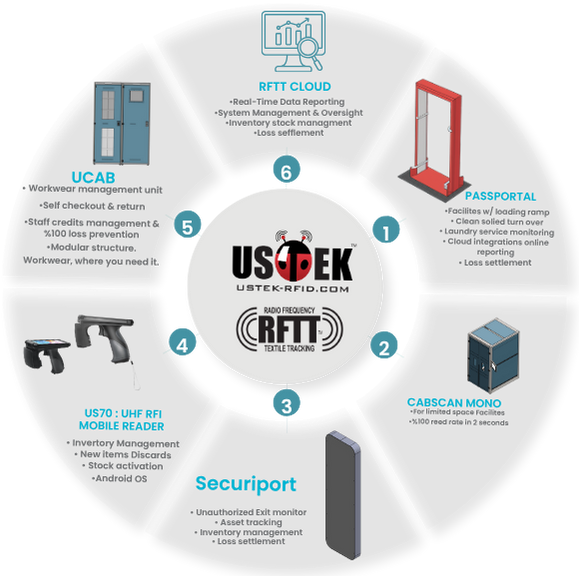
All textile items are registered in the system with RFID tags. Products are automatically read at cabinets, gates, mobile readers, and transition points, enabling real-time tracking of every movement.
Check-in/check-out, usage, laundry, and stock statuses are recorded automatically without manual intervention. Unauthorized exits and losses are instantly detected, and loss or damage processes are managed automatically.
All data is reported in real time via RFTT Cloud. Inventory status, usage rates, loss analysis, and operational performance are monitored and managed from a single centralized platform.